








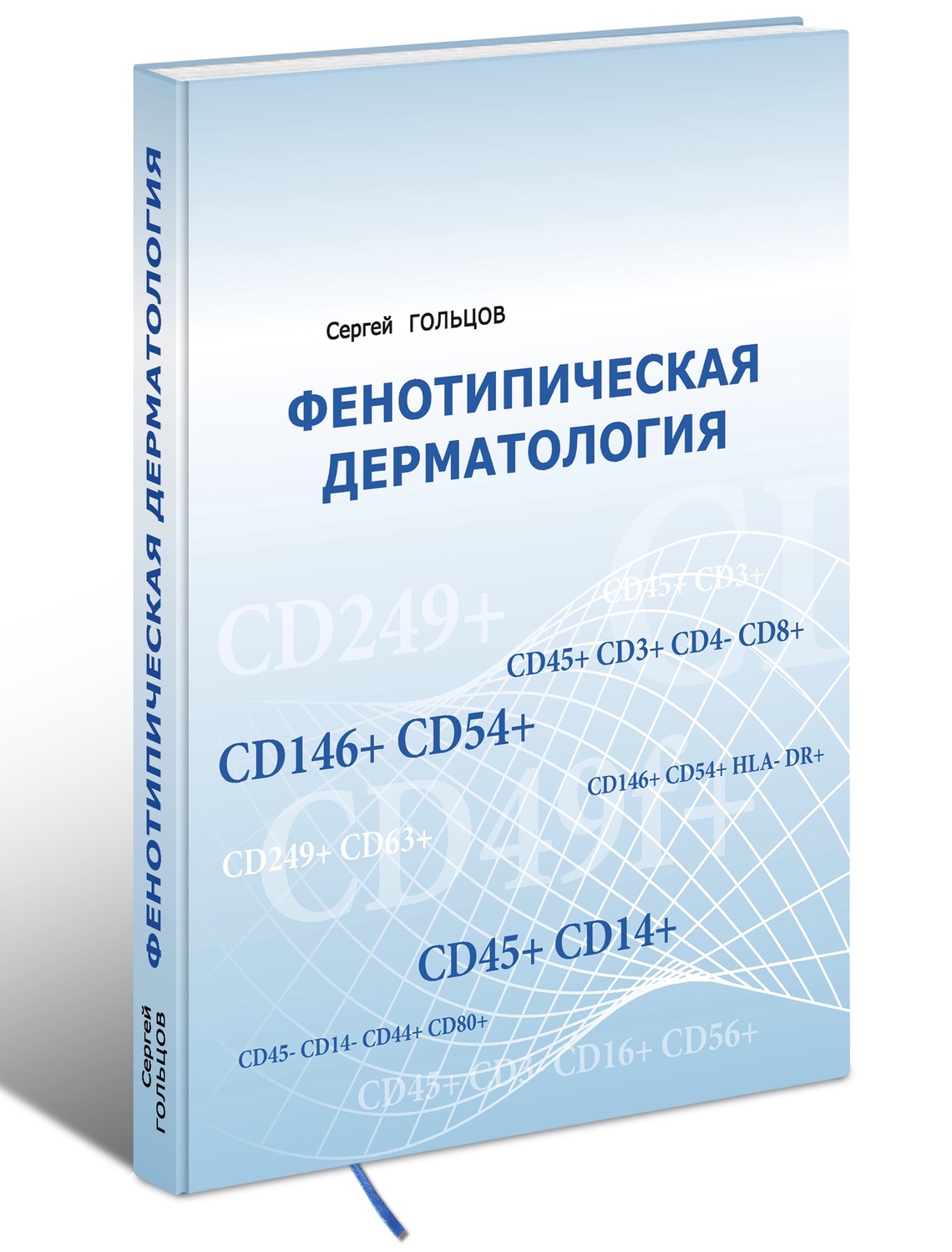
This volume represents the first book dedicated to the emergence of a new scientific discipline: phenotypic dermatology. It is not merely a reformulation of dermatologic thinking, but a fully developed scientific theory situated at the intersection of experimental dermatology, cytology, immunology, and conceptual analysis.
A defining feature of this approach is the use of flow cytometry to analyze viable skin cells. This methodology enables not only the characterization of pathological processes, but also their observation in real time, the selection of personalized therapeutic strategies, and the construction of fundamentally new diagnostic models.
The foundation of the book is an officially registered scientific invention: a method for isolating skin cells while preserving their viability. Its application is already yielding concrete clinical outcomes, which are described in detail throughout the monograph.
This publication is intended for dermatologists at all levels of training—from students to senior faculty. For the former, it provides a platform for future research; for the latter, it demonstrates how long-standing clinical challenges can be reframed and solved when traditional morphology gives way to the phenotypes and functional states of skin cells.
Preface
This book is not merely a scientific work; it is, in a sense, a manifesto— a declaration that dermatology stands on the threshold of a paradigm shift. After twenty-five years of clinical practice as a dermatologist, I have finally allowed myself to state openly: the traditional diagnostic framework, grounded in visible eruptions and morphological elements, no longer meets the demands of contemporary medicine. It traps the clinician in a loop of subjectivity: “a dermatologist treats what he sees, and sees only what he knows.” Yet diseased skin is far more than an assortment of macules, papules, plaques, and other elementary lesions.
What I offer here is a new perspective—phenotypic dermatology.
It is a shift of focus inward, to the level of viable skin cells, their phenotypes, and their intricate intercellular relationships. In this paradigm, the unit of analysis is not a morphological lesion but a living cell and its place within the tissue microenvironment.
Building upon flow cytometry and the technologies I have developed, it becomes possible to measure—objectively and reproducibly—what previously escaped visual assessment: the composition of skin-cell subpopulations, their dynamics, their patterns of interaction, and their responsiveness. These data form the basis of the skin cytoimmunogram—a functional map of the skin that enables precise, individualized therapeutic decision-making. Through this approach, a path opens toward a future form of dermatology—more scientific, more accurate, and more intellectually honest.
The book begins with a philosophical and historical analysis: why the empirical paradigm has reached its limits and what conceptual blind spots it perpetuates. I then attempt to substantiate the phenotypic approach, both theoretically and experimentally. This section includes results from my own research and observations—among them patented inventions—that have allowed a fundamentally new view of the dynamics of cellular subpopulations in human skin. The immunological phenomena revealed through these studies reshape our understanding: they make it possible to perceive not only the clinical manifestations but also the hidden mechanisms of skin disease. And that, surely, is of critical importance.
The path I chose required stepping beyond conventional clinical logic. I turned to conceptual analysis in order to find a language capable of describing these new phenomena. Indeed, it is the diversity of intercellular relationships that gives rise to the properties determining skin health or disease. Exploring this diversity elevates dermatology to a new level—the phenotypic level—enabling us to assert that “what exists is measurable, even when the physician cannot see it.”
By proposing that the “unit of measurement” of skin states should be the phenotype of a cell subpopulation, I am fully aware of the radical nature of this shift. Yet such a shift is necessary. It opens an extensive array of new research questions and therapeutic opportunities—a transformation difficult to resist once its logic becomes clear.
Phenotypic dermatology is a new scientific paradigm in which the diagnosis and treatment of skin diseases rely not on visual features, but on objective characteristics of cellular phenotypes and their interactions.
Unlike classical dermatology, which is rooted in the description of morphological elements of the rash, phenotypic dermatology views the skin as a dynamic system of cellular subpopulations and their immune microenvironment.
Its methodological foundation is flow cytometry and the skin cytoimmunogram—a method I developed for obtaining and analyzing viable skin-cell suspensions in order to determine their subpopulation composition, phenotypes, and functional states. This approach enables a transition from subjective diagnosis to precision dermatology—accurate, quantifiable, and individualized—where the “unit of measurement” is the phenotype of a cell rather than a clinical symptom.
Phenotypic dermatology integrates principles of cell biology, immunology, and systems analysis, forming the basis for personalized therapy. It opens pathways for predicting disease trajectories, selecting optimal therapeutic interventions, and evaluating treatment efficacy. In doing so, it lays the foundation for a new, scientifically grounded and measurable dermatology—a dermatology of phenotypes.
The practical section of the book is presented concisely. Although the number of observations is far greater, the aim was not to overwhelm with volume. The chosen examples sufficiently illustrate the method for obtaining viable skin-cell suspensions, constructing cytoimmunograms, and applying this knowledge in conditions such as atopic dermatitis, pemphigus, psoriasis, eczema, and other skin diseases. The approach described allows not only the documentation of symptoms, but also the prediction of disease progression and the selection of optimal therapeutic strategies.
In the concluding chapters, I share what I consider the central insight of my scientific journey: dermatology must move beyond the visually descriptive stage and transition to a phenotypic level of understanding. Such a transition opens new horizons for clinicians and researchers alike—from more precise diagnostics to more predictable therapeutic outcomes. Phenotypic dermatology represents a shift from conjecture to measurability, from surface observation to true depth.
I invite you to take this journey with me.
Yours,
Sergey Goltsov