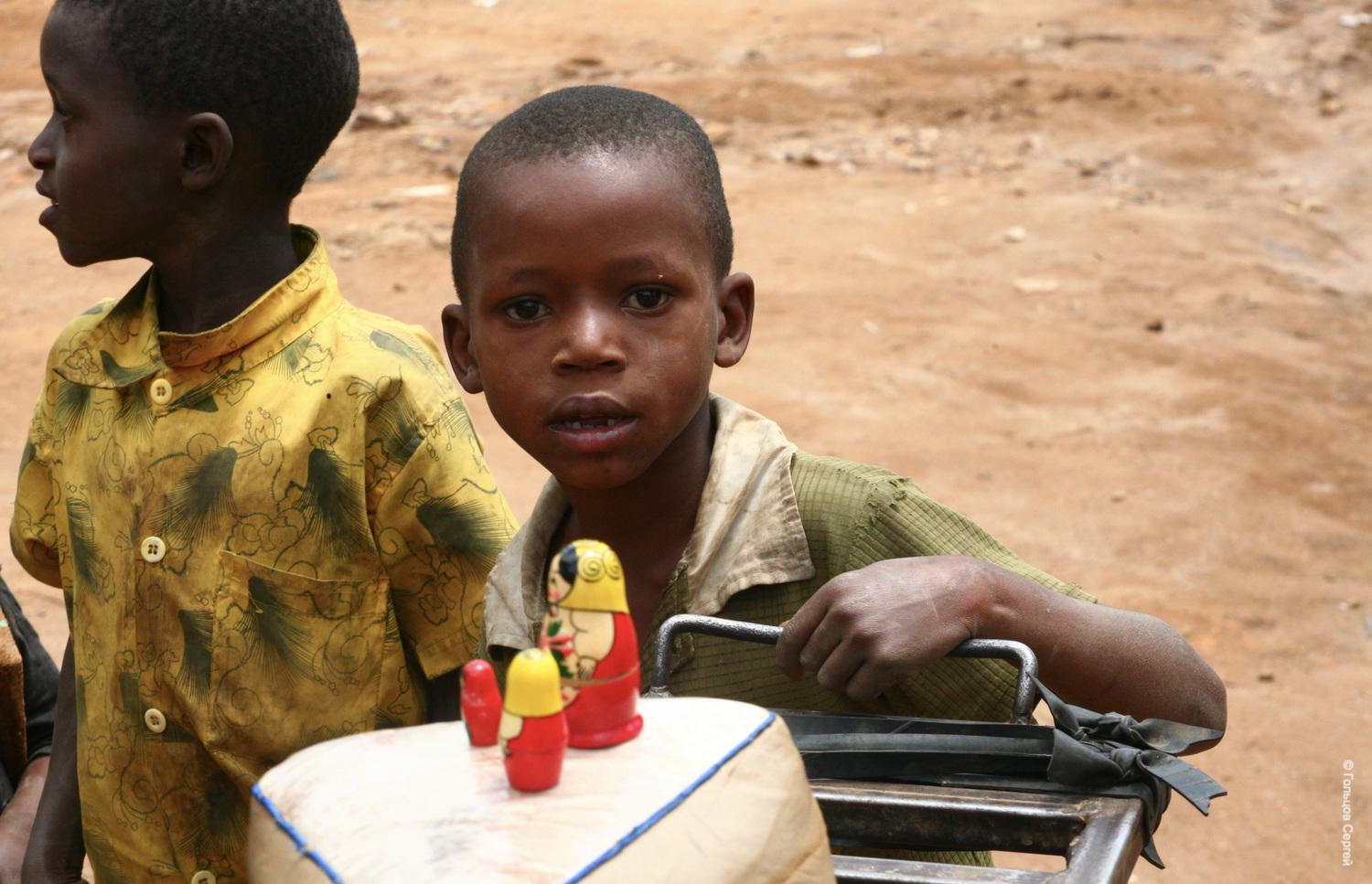
When you first find yourself in Africa, it feels like you're going to see other people. But a few days pass, and it becomes clear that Africa is actually showing you yourself.
There is nothing exotic in these photos. More precisely, it exists, but it quickly ceases to be the main thing. Tattoos on the arms of the driver, white patterns on the faces of young men, an old man with stretched earlobes, children in bright clothes, shepherds among acacias, dancing at round huts — all this first attracts the eye, and then suddenly recedes into the background.
That leaves a man.
An old man leaning thoughtfully on a stick is not much different from any wise old man in a Russian village. A girl with a notebook by a mud-brick wall looks as seriously into the future as a schoolgirl in Tyumen. A boy running along the ocean shore is not running along the African coast or the Rwandan coast — he is just running towards life.
We are used to measuring civilizations by technology, cities, internet speed, and building height. But as you travel through Tanzania and Rwanda, you start to notice something else. What matters is not how different cultures are, but how much the same people remain.
Parents everywhere take care of their children.
Children are laughing everywhere.
Old people everywhere are remembering the past.
Young people everywhere are dreaming of the future.
Clothes, jewelry, languages, and rituals vary. But joy, curiosity, dignity, love, and anxiety look the same under any sky.
That's probably why traveling is not necessary to see the world. The world is already huge and infinitely diverse. They are needed in order to unexpectedly discover a simple thing among this diversity: human nature is much more unified than we think.
And then Africa ceases to be a distant continent.
She becomes a mirror.